The news about artificial intelligence contains a lot of hype about whether it will take our jobs or possibly kill us all, or, on the other hand, discover new medicines to cure disease and solve scientific puzzles.
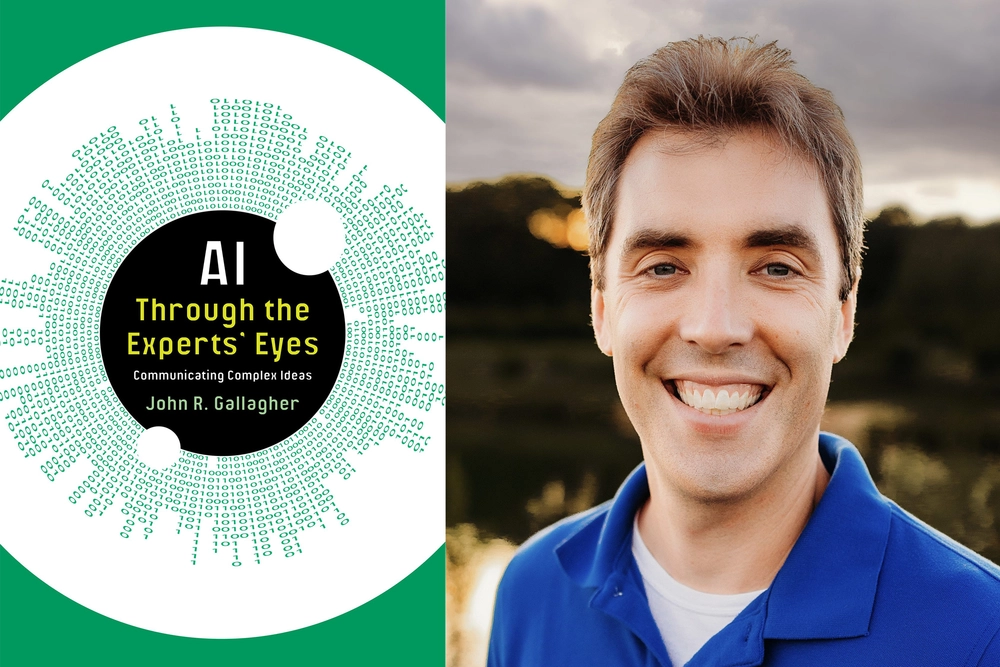
A new book by University of Illinois Urbana-Champaign English professor John Gallagher aims to counter the hype by focusing on the people who work on AI and machine learning. His book “AI Through the Experts’ Eyes: Communicating Complex Ideas” examines what AI researchers do and how they communicate about their work. His goal is to help those experts communicate without hype and help others better understand and think critically about AI, particularly writing teachers or those wrestling with the role of AI technology in their classrooms.
Gallagher — who is affiliated with the School of Information Sciences and is teaching two classes this semester on AI — said he wanted to learn more about machine learning and natural language processing techniques for his research. When the COVID-19 pandemic derailed his plans to visit AI research centers, he switched to interviewing machine learning researchers about their work and their communication techniques. He interviewed more than 100 AI and machine learning experts, most of whom were in academia and in the computer science and physics disciplines.
The public may envision killer robots when they think about AI, but in reality, it is mostly mundane tools, such as the GPS software for vehicle navigation or the spam filter on your email account, Gallagher said. And creating them is the methodical work of designing a model, obtaining feedback and revising it over and over again.
“It’s boring. It’s math, a lot of math, and meetings and day-to-day normalcy,” Gallagher said. The leaders of AI companies talk about “fanciful answers and magic in the sky, not linear algebra.”
“I’m less concerned with Terminator and HAL 9000 and more concerned with the systematic error that didn’t get picked up as a bug in the code, called the alignment problem. The program still works but it’s not exactly what you wanted it to do, and it’s now doing something kind of bad,” he said.
An example he wrote about in his book is a garbage-detection program called TrashCan, designed to clean up ocean garbage patches, and the problem of training a machine to recognize what is trash.
“If it is trained on objects not meant to be in the water, you can train a machine to pick up trash. But maybe you have a buoy that’s supposed to be there and is not trash, until it sinks onto the ocean bottom and it is trash. That’s an alignment problem if it collects buoys that are supposed to be there,” Gallagher said. “Or you train it on sea life. What if you get land animals swimming? It might see them as trash and collect them.”
The problem is not an evil robot, he said; it’s bad programming leading to an unintended result.
Much of the reason for the hype that either scares us or overpromises what AI can do is the hypercompetitive atmosphere in a field that is changing rapidly, he said. Researchers in academia and industry are expected to publish frequently at conferences, rather than in peer-reviewed journals that take much longer to release a paper. That pressure may lead researchers to overstate their findings or understate their limitations, Gallagher argued in the book.
Additionally, it’s no longer enough just to publish. Almost everyone Gallagher talked to mentioned the pressure of building a public relations campaign around a paper, he said.
“Now you must advertise the paper on social media. It also needs a blog post, a GitHub repository of the code, shared results on LinkedIn, Bluesky, even YouTube videos,” he said. “You can be a researcher and you also have to be a content creator and influencer, producing a conference paper and also six other content genres.”
Gallagher wrote that “the current AI publication landscape may lower publication quality while possibly sensationalizing scientific results.”
He made several suggestions for countering the hype surrounding AI. He said researchers should stress that AI is a type of automation designed to serve a specific need, such as detecting trash in the ocean or making sense of vast amounts of scientific data.
AI and machine learning researchers should be trained and encouraged to translate their research for many different audiences, including nonexperts, and they should discuss their work in the media, including explaining the technical, granular aspects of their work on long-form platforms such as YouTube, he said.
Incentives are needed to reduce the pressure on academic publishers — particularly those for conference proceedings — that encourage them to produce a high quantity of articles in a short time frame, Gallagher said.
Finally, he said that nonexperts interested in learning more should seek out technical AI researchers rather than business leaders promoting their products or podcasters seeking an audience. Many researchers have YouTube channels devoted to explaining the technical details and concepts of the field that will demystify AI technology, he said.
Editor's note: This story was originally published by the Illinois News Bureau.