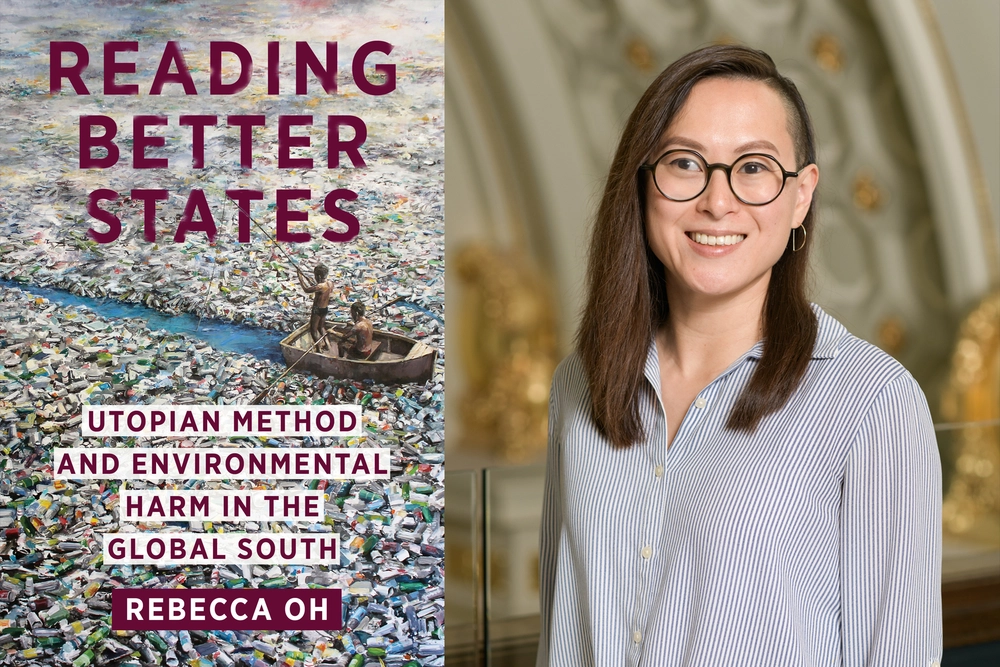
Citizens and writers remain hopeful in the face of environmental harms in “Reading Better States: Utopian Method and Environmental Harm in the Global South,” the new book by University of Illinois Urbana-Champaign English professor Rebecca Oh.
Oh said she was interested in how people and writers in the Global South see their futures when they are threatened by environmental problems that can’t be repaired. Her research expertise is in postcolonial studies and environmental humanities, and, in her fields of scholarship, the state is seen as a bad actor and a source of violence.
But during her research, Oh saw repeated instances of citizens and writers who were both critical of their governments and also were petitioning them to provide protections from environmental harms and to push back against capitalist interests and environmental racism. They were imagining an alternative future with positive potential, she said.
“It was simultaneously a critique but also an attachment to the actions the state could take. Their complaints weren’t just a catalog of negativity but also a demand on power,” Oh said. She looked at legislation, court decisions, novels, poetry, and films. Her book looks at several examples of environmental harm and climate change, and the responses to them.
Oh said postcolonial states were expected to provide social justice to their citizens after gaining independence, but they often continued to perpetuate the colonial structures that prioritized capitalist interests over social provisions. Protection against environmental harms were sacrificed to resource extraction or development of prestige projects. Her book sees the state and its relationship with its citizens as more complex.
She wrote about the 1984 gas disaster in Bhopal, India, the worst industrial disaster in history. A pesticide factory operated by the Union Carbide Corporation exploded, killing several thousand people, leaving hundreds of thousands injured or with long-term health complications, and polluting the area’s soil and groundwater. A 1989 settlement was considered insubstantial, Oh said.
But in the five years between the accident and the settlement, the government passed a law regarding the processing of claims that took a wide view of the grounds on which victims could seek compensation, including on behalf of unborn children. An initial civil suit accused Union Carbide of being liable for a huge range of harms caused by the explosion.
“All that was closed down in the settlement, which was really narrow,” Oh said. “But at the same time, people don’t accept that settlement as final. They keep asking for government redress. The state is still the tool they are using to demand health care and cleanup.”
Likewise, the Nigerian government has tried, through legislation or court proceedings, to hold corporations accountable for damage caused by oil spills in the Niger Delta, Oh said.
“The court rulings haven’t been enforced but they can’t be dismissed,” she said. Nigerian writers have likewise critiqued the state and imagined alternative versions of the state that could enforce environmental justice.
Oh also looked at the actions of Cape Town, South Africa, in facing a severe drought during which it might have run out of water. The city, which had been taking steps to address its inadequate water infrastructure, instituted water-use restrictions. City officials called out “water heroes” who were doing their part and also spotlighted water delinquents ― most of whom were wealthy white suburbanites ― who were violating the restrictions.
“The government acknowledged that they were the problem and went after them, rather than blaming poor residents,” Oh said.
Finally, she looked at the Pacific atolls of Tuvalu, Kiribati, and the Marshall Islands, all of which are at risk from rising sea levels. Their actions have varied, including building sea walls and other infrastructure, and using diplomacy to persuade large carbon producers to mitigate their carbon emissions. “They only have so much clout, but they are punching above their weight because of their high moral ground,” Oh said.
They’ve also addressed the possibility that their citizens might become climate refugees. Some have resisted the idea of moving, but Kiribati formed a “Migration with Dignity” plan that accepted the reality that its citizens might have to move. The plan called for building on the diaspora where others lived and taking steps to safeguard the atoll’s national culture and community. Oh said the plan can also be read as a speculative policy that reimagines what statehood means without territory, a functioning government, and a static population.
She said environmental concerns are just as much grounds for engaging with the state as voting, participating in demonstrations, and other forms of civic life. Often, the demands for environmental protection by the communities she wrote about were part of other demands for civic representation and better services.
“All the communities I’m writing about are disenfranchised, with weak citizenship. They don’t have robust rights or belonging. They are marginalized communities. Those are the communities that experience the most environmental violence,” she said.
It takes a different way of thinking to look beyond the negative critiques of government and harmful situations to find any positive potential in the future, Oh said, but complaints are also a demand.
“You don’t complain about things you don’t care about. The complaints are directed at people who have the power to intervene. People are seeing unfulfilled promises as sites of future potential rather than sites of closure. The state is Janus-faced, both a bad actor and a site of appeal,” she said.
“This gives me hope in bad times, to try to see what else is going on with things that are so negative so far into the future,” Oh said. “There is a lot of pain and a lot of injustice, but people haven’t given up. They have a commitment to something better, and in writing this book, I tried to follow those pursuits.”
Editor's note: This book was originally published by the Illinois News Bureau.